[ Cluster A ]
How many employees really use Copilot every day?
In the two public pilots with open data, Australia and the UK, about a third of licensed users were using Copilot every day. The figure shifts with the definition of "active": for Microsoft, a single action in 28 days is enough.
By Matteo Garoli, Founder, Besidera
-
 Microsoft 365 Copilot
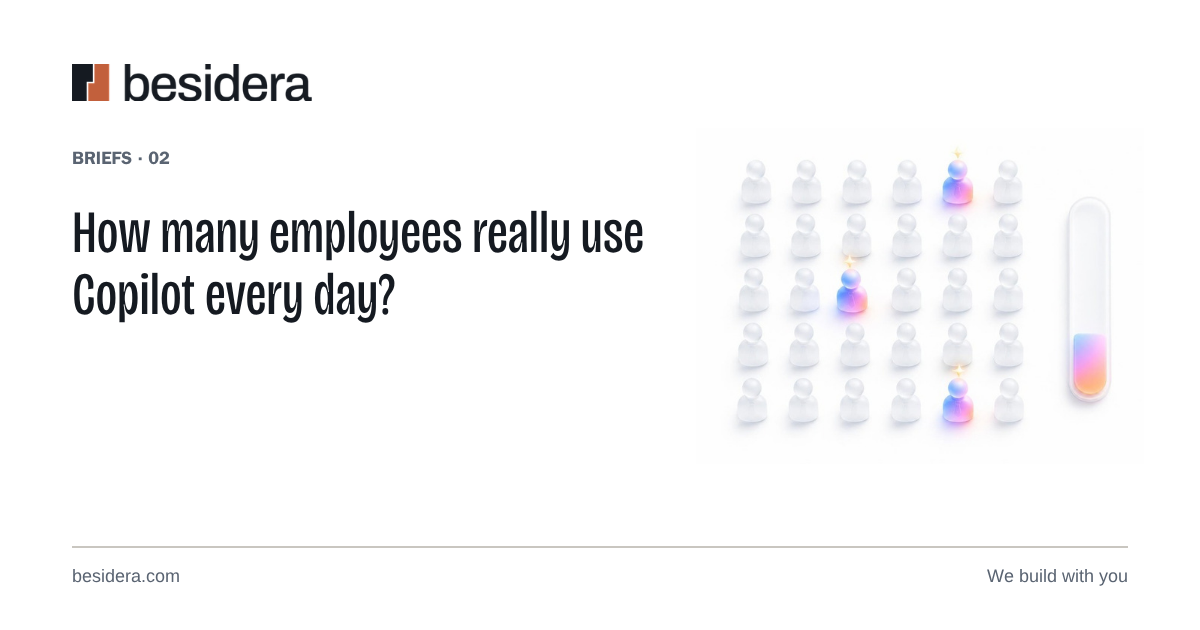
About one in three, according to the only open data we found: the 2024 pilots run by the Australian and UK governments. In Australia 32% reported daily use; in the UK, an average of 30% of licensed users were active on working days. Microsoft does not publish the ratio of seats sold to daily users.
What does Microsoft say about how much Copilot is used?
It reports seats sold and usage intensity going up, without saying how many licence holders use Copilot every day. In the earnings calls, paid Microsoft 365 Copilot seats went from 15 million (28 January 2026) to over 20 million (29 April) and then to over 30 million (29 July).
On usage, in January Satya Nadella said that daily active users had grown tenfold in a year, without giving the starting figure. In April weekly engagement was at the level of Outlook, and in July at the level of Outlook and Teams. These are vendor statements with no denominator, and the calls do not explain how “engagement” is measured. For scale: in January paid commercial Microsoft 365 seats stood at over 450 million, and Copilot’s 15 million were about 3% of them (our calculation).
How many licensed users use Copilot every day in the public pilots?
About a third in both cases we found, although the two studies count in different ways. Australia’s Digital Transformation Agency published its trial evaluation in October 2024, covering the trial run across the public service from January to June 2024. In the final survey (811 responses), 32% used Copilot several times a day or for most of the day, 46% a few times a week and 21% a few times a month. Yet 86% of respondents wanted to keep using it: the report describes moderate use despite the positive verdict.
The UK’s Department for Business and Trade issued 1,000 licences for three months, from October to December 2024 (about 70% to volunteers). Its evaluation of August 2025 used data from Microsoft’s dashboard: on average 21% of licensed users were active each day, 30% excluding weekends and public holidays, and 64% each week.
| Australia (DTA) | UK (DBT) | |
|---|---|---|
| Period | January to June 2024 | October to December 2024 |
| How it was counted | final survey, 811 responses | Microsoft dashboard data, 1,000 licences |
| Every day, across all days | not measured | 21% |
These are pilots from 2024, with largely volunteer participants and a product that has changed since. In Australia the answers are self-reported; in the UK they are measured. They do not represent the market.
Is the 35.8% “active use” figure that circulates online reliable?
It is a real figure, but it does not measure daily use of the seats sold. It comes from Recon Analytics, which on 4 February 2026 published an analysis of over 150,000 respondents to a US survey (July 2025 to January 2026). The figures quoted cover only paying subscribers to AI tools. Recon uses “workplace conversion” for the share of people who adopt a platform that is available to them at work: Copilot 35.8%, Gemini 34.0%, ChatGPT 83.1%. The public page does not define the term precisely and the full report is behind a paywall. When Copilot is the only tool the employer provides, the same analysis shows 68% adopting it as their main tool.
In several blogs we read, the figure appears with no source or with second-hand references. If you find it in a document, ask which population and which metric it refers to.
How do you measure real Copilot adoption?
With several measures together, because “active user” on its own tells you too little. In the Copilot Dashboard a user is active if they have taken at least one action in the last 28 days: sending a prompt counts, opening the side panel does not. Someone who tries it once in four weeks weighs as much as someone who uses it every day. The usage report in the admin centre offers 7, 28, 90 and 180-day windows and the date of each licensed user’s last activity.

To capture habit, the Dashboard classifies users over 12 weeks. Power users average at least 15 actions a week and use Copilot in at least 9 of the 12 weeks; habitual users average 1 to 14 actions, again in at least 9 of the 12 weeks; novice users have at least one action but in fewer than 9 weeks. There is also the share of people who come back compared with the previous period. The adoption measures cover people who have an assigned licence.
In the projects we run, we start from the share active over 7 days, then look at habitual users, by role rather than across the whole company. Finally we ask each group which specific task has moved into Copilot: no dashboard calculates that number, you define it. For the step from usage to financial return, see how to measure Copilot’s ROI.
Where do people go when they have a licence and don’t use it?
When they have an alternative, many adopt another AI tool. In Recon’s analysis, among workers who have both Copilot and ChatGPT available, 18% adopt Copilot and 76% ChatGPT; with Gemini as well, Copilot falls to 8% (ChatGPT 70%, Gemini 18%). This is a sample of paying subscribers: it says nothing about people who do not use AI at all. In the Australian trial 16% of respondents also used other generative AI tools for work, and 44% of them found those tools better suited to their needs.
What gets Copilot use to go up?
Training tied to people’s daily work and specific use cases, according to the few data points available, which mostly measure confidence. In the Australian trial 75% of those who had received three or more forms of training felt confident using Copilot, 28 points more than those who had received only one, and the evaluation says that identifying specific use cases can increase use.
In our experience daily use goes up when a specific task, manual today, moves into Copilot and someone owns the result: that is the work of our adoption and change management projects. We wrote about why pilots stay pilots in why licences end up being used for email; the next step is from pilot to rollout.
Frequently asked questions
Do the 30 million seats include people using Copilot Chat without a paid licence?
No, they are paid seats. On the 28 January 2026 call Microsoft said that users of Copilot Chat without a Copilot licence were far more numerous than the 15 million seats at the time. The Copilot Dashboard shows them in a separate view.
Is there a percentage of active users you can take as a target?
Not a public, verifiable one: the thresholds that circulate online often have no primary source. The Copilot Dashboard compares your group with similar groups in your organisation and, with at least 50 Copilot or Viva Insights licences, with other companies (at least 20 for each comparison). As a first target, comparing yourselves with yourselves, month on month, works best.
How often does the data refresh, and can you see people's names?
The Dashboard updates every day, but it shows the last 28 days with a delay of up to six days; the usage report in the admin centre normally arrives within 48 hours. By default, names in usage reports are hidden: an administrator can reveal them, and it is worth talking to HR and trade union representatives first.
Useful resources
- Microsoft Copilot Dashboard
Explains the readiness, adoption and impact metrics, the definition of an active user and the 12-week usage tiers (power, habitual, novice).
- Microsoft Copilot usage report
The Microsoft 365 admin centre report: active users by app, 7, 28, 90 and 180-day windows, and the date of each licensed user's last activity.
- Evaluation of the M365 Copilot pilot in the Department for Business and Trade
The UK government report, with daily and weekly usage data taken from Microsoft's dashboard and the full methodology.
Sources
- FY26 Q2 earnings conference call, Microsoft Investor Relations, 28 January 2026
- FY26 Q3 earnings conference call, Microsoft Investor Relations, 29 April 2026
- FY26 Q4 earnings conference call, Microsoft Investor Relations, 29 July 2026
- Evaluation of the whole-of-government trial of Microsoft 365 Copilot: employee related outcomes, Digital Transformation Agency, Australian Government, 23 October 2024
- Evaluation of the M365 Copilot pilot in the Department for Business and Trade, Department for Business and Trade, UK Government, 28 August 2025
- AI Choice 2026: Why Licenses Don't Equal Adoption, Recon Analytics, 4 February 2026
- Connect to the Microsoft Copilot Dashboard for Microsoft 365 customers, Microsoft Learn, updated 29 September 2026
- Microsoft Copilot Usage Report, Microsoft Learn, updated 14 July 2026